
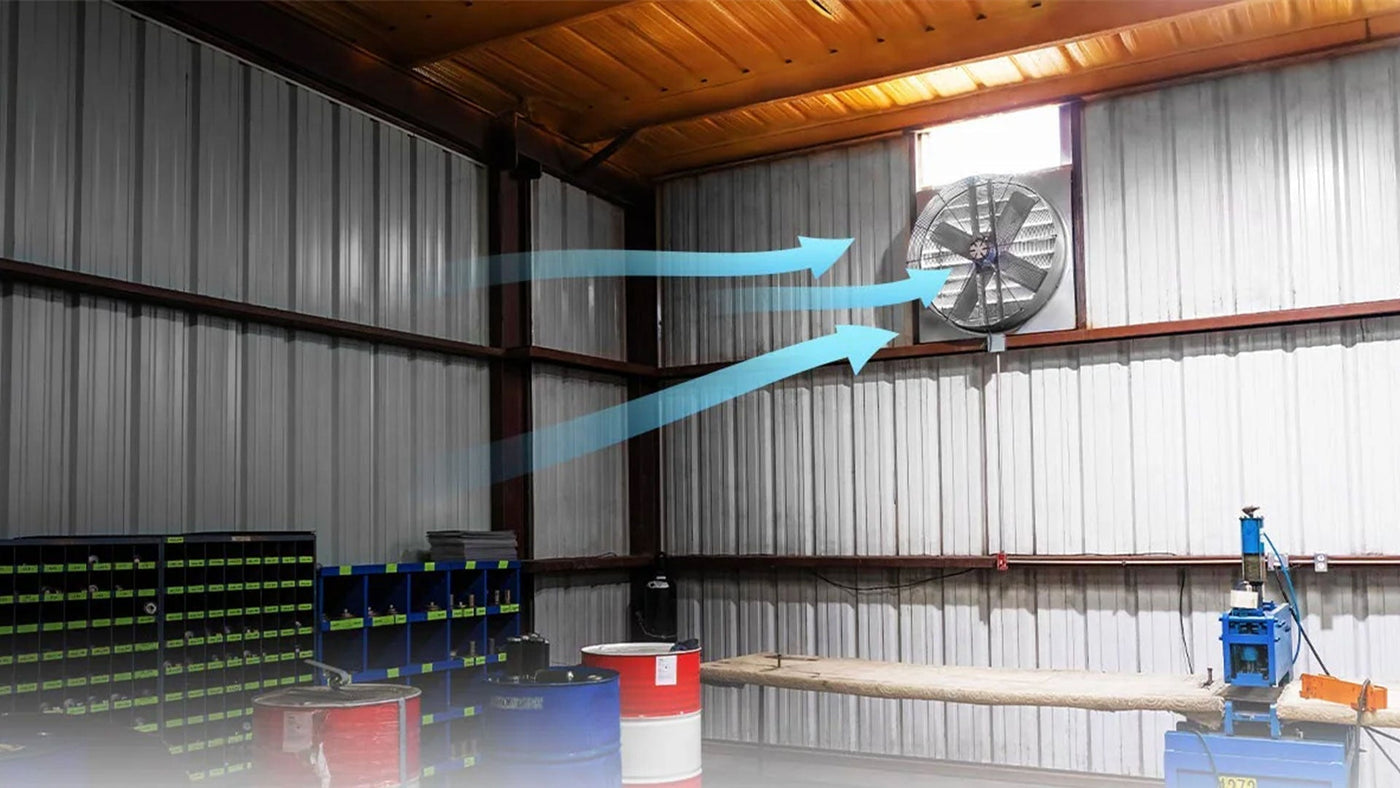
This chapter pulls together the most common questions people ask about fans across the full Maxx Air lineup: ceiling fans, drum fans, pedestal fans, wall-mount fans, exhaust fans, attic ventilators, whole-house fans, HVLS commercial fans, misting fans, and bathroom fans.
Cooling & Comfort
Does a Fan Cool a Room?
A standard circulation fan does not lower the temperature of a room, it creates a wind-chill effect that makes people feel cooler. Ceiling fans, pedestal fans, drum fans, and wall-mount fans all work this way. The exceptions are exhaust fans, attic fans, and whole house fans, which actively move hot air out of the space and pull cooler air in, lowering the actual room temperature.
Should I Use a Fan or Air Conditioner?
Fans and air conditioners work differently and often work best together. Air conditioners actually lower air temperature; fans create a wind-chill effect that makes the same temperature feel cooler. Running a fan with the AC lets you raise the thermostat 3 to 4 degrees while feeling the same comfort, which can reduce cooling costs by 5 to 10 percent.
What Is the Best Fan for a Hot Room?
The best fan for a hot room depends on the room and the cause. For a stuffy room with no ventilation, a pedestal fan or high-velocity floor fan moves the most direct airflow. For a consistently hot upper-floor room, an attic fan or whole house fan addresses the root cause. For a garage or workshop, a drum fan or wall-mount fan handles the load that standard fans can not.
Fan Energy & Operating Cost
Do Fans Use a Lot of Electricity?
No. Most residential ceiling and pedestal fans use 50 to 100 watts on high speed, while DC-motor fans use 15 to 50 watts. Industrial drum fans and HVLS commercial fans use more (300 watts to several kilowatts depending on size) but deliver more airflow-per-watt than running multiple smaller fans for the same coverage.
How Much Does It Cost to Run a Fan?
At average U.S. electricity rates, running a typical ceiling or pedestal fan costs about 1 cent per hour on high speed, less on lower speeds. A large industrial drum fan or HVLS commercial fan costs more, typically 3 to 15 cents per hour depending on size. For most residential fans, the AC savings from being able to raise the thermostat outweigh the fan's own electricity cost by a significant margin.
Fan Type Quick Reference
What Is a Ceiling Fan?
A ceiling fan is a circulation fan mounted to the ceiling, typically with three to five rotating blades 30 to 96 inches in diameter. Residential ceiling fans circulate air in bedrooms, living rooms, and patios. Larger HVLS (high-volume, low-speed) ceiling fans cover commercial and industrial spaces up to several thousand square feet per fan.
What Is a Tower Fan?
A tower fan is a tall, narrow standing fan with a vertical airflow column. Tower fans are common in bedrooms, apartments, and offices where floor space is limited and quiet operation matters. They typically use bladeless or low-profile fan technology and prioritize comfort over high airflow.
What Is a Pedestal Fan?
A pedestal fan is a free-standing fan mounted on an adjustable-height vertical pole, usually with an oscillation feature. Pedestal fans range from 16 to 24 inches in residential models and 30+ inches in industrial versions. They balance airflow strength, portability, and adjustability better than most fan types.
What Is a Drum Fan?
A drum fan is a portable, free-standing fan with blades enclosed in a cylindrical drum-shaped housing. Drum fans range from 24 to 60 inches in diameter and deliver several thousand CFM of focused airflow. They are built for garages, workshops, gyms, warehouses, agricultural buildings, and construction sites.
What Is a Wall-Mount Fan?
A wall-mount fan is a high-velocity fan attached to a wall surface, usually with an adjustable head that tilts and swivels. Wall-mount fans keep floor space clear and stay above dust lines, which makes them standard in garages, workshops, warehouses, and commercial spaces.
What Is an HVLS Fan?
HVLS stands for High-Volume, Low-Speed. An HVLS fan is a large ceiling fan, typically 7 to 24 feet in diameter, designed to move massive amounts of air at slow speeds. A single HVLS fan can cover thousands of square feet, which makes it the standard solution for warehouses, manufacturing floors, gyms, and agricultural buildings.
What Is an Attic Fan?
An attic fan is installed in the roof, gable, or attic wall to pull hot air out of the attic space and replace it with cooler outside air through soffit vents. Attic fans typically reduce summer attic temperatures by 20 to 40 degrees, which lowers the home's air conditioning load.
What Is a Whole House Fan?
A whole house fan is a large fan installed in the ceiling between the top floor and the attic. It pulls cool outside air through open windows and pushes hot air out through attic vents, exchanging the entire home's air in 10 to 30 minutes. They work best in climates with cool evenings.
What Is a Misting Fan?
A misting fan is a standard fan combined with a misting system that sprays fine water droplets into the airstream. The water droplets evaporate rapidly in the moving air, lowering the effective temperature by 10 to 30 degrees in dry climates. Misting fans work best in outdoor spaces and dry environments where the mist can evaporate fully.
What Is an Exhaust Fan?
An exhaust fan pulls air out of a space and vents it outside, removing humidity, odors, smoke, fumes, and pollutants. Bathroom exhaust fans remove shower moisture, kitchen exhaust fans pull out cooking smoke and grease, and industrial exhaust fans remove heat, dust, and fumes from working environments.
How Different Fan Types Work
How Does an Exhaust Fan Work?
Exhaust fans use a motor-driven blade or impeller to pull air from inside a space and discharge it outside through ductwork. As exhaust air leaves, fresh air enters through cracks, vents, or open windows to replace it. Always vent exhaust fans to the outside, never into attic spaces or wall cavities.
How Does a Whole House Fan Work?
A whole house fan pulls cool outside air through open windows and pushes hot indoor air up through the attic and out through roof or gable vents. The result is a complete air exchange across the entire home in 10 to 30 minutes. Whole house fans require open windows during operation and adequate attic venting to handle the exhausted airflow.
How Does a Misting Fan Work?
A misting fan combines moving air with a fine water mist. The water droplets evaporate rapidly in the airstream, and that evaporation absorbs heat from the surrounding air. The result is effective temperature drops of 10 to 30 degrees, depending on humidity. Misting fans are most effective in dry climates and outdoor spaces.
Do Attic Fans Work and Are They Worth It?
Yes, attic fans work and are usually worth it in hot-summer climates and in homes where the upstairs runs significantly hotter than the downstairs. A properly sized attic fan reduces summer attic temperatures by 20 to 40 degrees, lowering the air conditioning load. They work best when paired with adequate soffit venting.
Sizing & Airflow
What Does CFM Mean?
CFM stands for Cubic Feet per Minute, the standard measurement of how much air a fan moves in one minute. CFM is the most useful single measure of fan airflow because it accounts for both blade speed and blade size. A small bedroom fan might be 1,000 to 2,000 CFM; an HVLS commercial fan can exceed 100,000 CFM. For sizing your fan by room, see Chapter 7.
How Many CFM Does a Bathroom Fan Need?
A bathroom fan should provide at least 1 CFM per square foot of bathroom space, with a minimum of 50 CFM. The Home Ventilating Institute (HVI) recommends 80 CFM for bathrooms with showers or tubs. For larger bathrooms or those with multiple fixtures, add 50 CFM per toilet, 50 CFM per tub or shower, and 100 CFM per jetted tub.
For Deeper Coverage on Related Topics
- Sizing fans for specific rooms, CFM by space, downrod calculations → see Chapter 7
- Quiet fans, fan noise levels, dB ratings by fan type → see Chapter 8
- Outdoor fan ratings, damp vs wet, industrial durability → see Chapter 9
- Residential vs commercial vs industrial vs agricultural use → see Chapter 10
- Installation, mounting, downrods, costs → see Chapter 12
- Cleaning, maintenance, lifespan by fan type → see Chapter 13
- Common buying mistakes → see Chapter 14