
A fan for a bedroom and a fan for a warehouse may both be called fans, but they have almost nothing in common. One is built for quiet comfort in a 150-square-foot room. The other is part of a system designed to keep workers comfortable across 30,000 square feet of open floor space.
The difference between residential and commercial fan applications comes down to airflow demand, durability, mounting, run time, and control needs. Choosing well starts with knowing which category your space falls into.

What Counts as Residential, Commercial, Industrial, and Agricultural?
The terms are used loosely, but they generally refer to different scales of use and types of buildings.
|
Category |
Typical Spaces |
Common Demands |
|---|---|---|
|
Residential |
Bedrooms, living rooms, kitchens, bathrooms, home garages, patios, attics |
Comfort, quiet operation, visual appeal |
|
Commercial |
Offices, retail stores, restaurants, gyms, fitness studios, hotels |
Broader airflow, longer run times, employee and customer comfort |
|
Industrial |
Warehouses, factories, manufacturing facilities, distribution centers, workshops, auto shops |
High airflow, heavy-duty construction, continuous operation |
|
Agricultural |
Barns, livestock buildings, greenhouses, stables, plant nurseries |
Moisture and dust control, animal welfare, year-round operation |
Some spaces fall between categories. A home woodworking shop, for example, may technically be residential, but it has industrial-style airflow needs because of dust and equipment heat. A boutique fitness studio is commercial, but a 30,000-square-foot CrossFit warehouse is closer to industrial.
Residential Applications
Residential fans are built for comfort, quiet, and visual appeal.
Bedrooms and Living Rooms
These are the most common residential fan locations. Most bedrooms and living rooms work well with a ceiling fan in the 44- to 56-inch range, a quiet tower fan, or a pedestal fan with multiple speed settings.
Sound is usually the deciding factor. A fan under 40 dB is generally quiet enough to run overnight without being distracting.
Kitchens and Bathrooms
These spaces deal with heat, moisture, and odors more than other rooms. Range hoods and bathroom exhaust fans are the primary tools here, not circulation fans. Bathroom fans are typically sized at 50 to 100 CFM depending on room size, and kitchen exhaust hoods may need 300 CFM or more.
Home Garages and Workshops
A home garage is technically residential, but the airflow demands are much closer to a commercial workshop. Heat builds up under metal roofs, dust collects from projects, and stored items can trap stagnant air.
A residential garage fan or workshop fan typically needs higher CFM than other home fans because these spaces lack the insulation and HVAC support of finished rooms.
High-velocity wall-mount fans are common in these spaces because they move large amounts of air without taking up floor space. A two-car garage usually needs at least 3,000 to 6,000 CFM to stay comfortable in summer.
What Is the Best Fan for a Garage?
The right fan for a garage depends on whether it is finished, partially conditioned, or unfinished. Yes, you can install a ceiling fan in a garage as long as it matches the conditions: damp-rated ceiling fans for garages with regular humidity, and standard dry-rated ceiling fans for finished, climate-controlled garages. For unfinished garages used as workshops or home gyms, pairing a permanent wall-mount fan with a portable pedestal fan delivers both whole-garage circulation and directable focused cooling for specific work areas.
Patios and Outdoor Living Spaces
Outdoor residential fans need to be damp- or wet-rated depending on exposure (covered in detail in Chapter 9). Misting fans, outdoor ceiling fans, and weather-resistant pedestal fans are the most common choices.
Attics and Basements
Attics often need dedicated attic exhaust fans to reduce trapped heat in summer. Basements typically need general circulation combined with dehumidifiers to control moisture.

Commercial Applications
Commercial fans face longer run times, larger spaces, and the need to keep both employees and customers comfortable.
Offices
Offices usually combine HVAC airflow with supplementary fans for hot zones or break rooms. Quiet tower fans, small pedestal fans, and ceiling fans are common. Noise matters because people are working and on calls.
A good office fan typically operates below 40 dB at medium speed and includes multiple speed settings so workers can adjust airflow without disrupting conversations or phone calls.
Retail Stores
Retail spaces need airflow that keeps customers comfortable enough to linger. A commercial ceiling fan in a retail space is typically larger and more powerful than a residential model, with longer run times and quieter operation at low speeds. In larger stores with high ceilings, HVLS fans (high-volume, low-speed) are increasingly used because they cover wide floor areas with gentle, even airflow.
Restaurants
Restaurants combine multiple airflow needs in one building. Kitchens require powerful exhaust to remove heat, smoke, and grease. Dining areas need circulation that does not blow on tables or guests. Outdoor patios often need wet-rated ceiling fans or misting fans for warm-weather seating.
A restaurant fan installation usually combines kitchen exhaust fans for heat and smoke removal with quieter ceiling fans or wall-mount fans in dining areas.
Gyms and Fitness Studios
Gyms generate heat, humidity, and stale air quickly. They need strong, continuous airflow without creating an uncomfortable wind blast on equipment. Large drum fans, wall-mounted fans, and HVLS ceiling fans are all common solutions. For a 5,000-square-foot gym, total airflow of 20,000 to 30,000 CFM is a typical baseline.
What Fan Is Used in a Gym?
The right gym fan configuration depends on the type and intensity of the facility. Traditional fitness studios usually need 4 to 6 fan placements that combine HVLS ceiling fans for broad circulation with drum fans positioned at high-traffic equipment areas. CrossFit boxes, hot yoga studios, and high-intensity gyms benefit from higher airflow rates than the 20,000 to 30,000 CFM baseline used for general fitness spaces, because concentrated body heat and humidity raise the cooling load significantly.
Hotels and Hospitality
Hospitality spaces often combine residential-style ceiling fans in guest rooms with commercial-grade fans in lobbies, pool areas, restaurants, and outdoor patios. The right fan in a guest room is quiet; the right fan in a pool deck is wet-rated and corrosion-resistant.
Industrial Applications
Industrial fans operate at a completely different scale.
Warehouses and Distribution Centers
Warehouses are some of the most demanding spaces for fan performance. Ceiling heights of 20 to 40 feet, large open floor plans, and limited natural ventilation make airflow a challenge.
HVLS ceiling fans are the most common solution. A single HVLS ceiling fan can cover up to roughly 4,300 square feet, and larger facilities use multiple fans in a grid pattern with overlapping coverage to prevent dead zones. A warehouse fan deployment typically pairs industrial ceiling fans for whole-floor coverage with high-velocity wall-mount fans for focused airflow at packing stations, and a large commercial fan in this category is often rated at 10,000 CFM or more.
For warehouses without air conditioning, fans are often the only realistic way to keep workers comfortable through summer.
How Do You Cool a Warehouse?
Beyond the HVLS-plus-focused-airflow approach described above, effective warehouse cooling adds roof or wall exhaust fans to remove trapped heat that builds up at ceiling level. Sizing follows a rule of one HVLS fan per 4,000 to 5,000 square feet of floor area, with smaller warehouses combining a single HVLS with high-velocity wall-mounted fans at picking and packing stations. ENERGY STAR certified ceiling fans include commercial HVLS models that meet specific airflow-per-watt standards, which matters when running multiple large fans continuously.
Factories and Manufacturing
Manufacturing spaces add heat, and machinery noise to the picture. Heavy-duty drum fans, wall-mounted fans, and industrial exhaust fans all play a role. Safety features like OSHA-compliant grilles and totally enclosed motors are critical. In safety-sensitive environments, high-visibility finishes such as safety yellow help workers identify equipment quickly.
Workshops and Auto Shops
Workshops and auto shops face heat, dust, and humidity all at once. Wall-mounted fans with totally enclosed motors hold up well because they stay above the dust line and resist clogging. By mounting fans on walls or support pillars, shops keep electrical cords off the floor, reducing trip hazards and protecting fans from rolling floor jacks. Exhaust fans are also common for removing vehicle exhaust and paint fumes.
Agricultural Applications
Agricultural fan applications fall somewhere between commercial and industrial, with their own specific challenges around heat, dust, moisture, and animal welfare.
Barns and Livestock Buildings
Livestock barns face heat, dust, ammonia from waste, and moisture all at once. Animals need consistent airflow to stay healthy and productive, and dust quickly destroys open-motor fans.
A barn fan or livestock fan must run continuously through summer without overheating, which is why totally enclosed motors and powder-coated steel construction are standard in agricultural-grade equipment.
Wall-mount fans with totally enclosed motors are standard because they stay above the dust line and resist clogging. Drum fans add focused cooling along aisle ways and stalls. Heavy-duty wall-mounted exhaust fans are commonly used to pull stale, humid air out of barns and replace it with fresh air drawn in through intake vents.
How Do You Cool a Barn?
The most important variable in barn cooling is air change rate. Target 4 to 6 air changes per hour for cattle and dairy operations and 8 to 10 air changes per hour for swine and poultry, where humidity and ammonia loads run higher. Sizing fans to hit those rates is more critical than fan count alone, because under-ventilated livestock buildings see measurable drops in animal health and productivity.
Stables and Equine Facilities
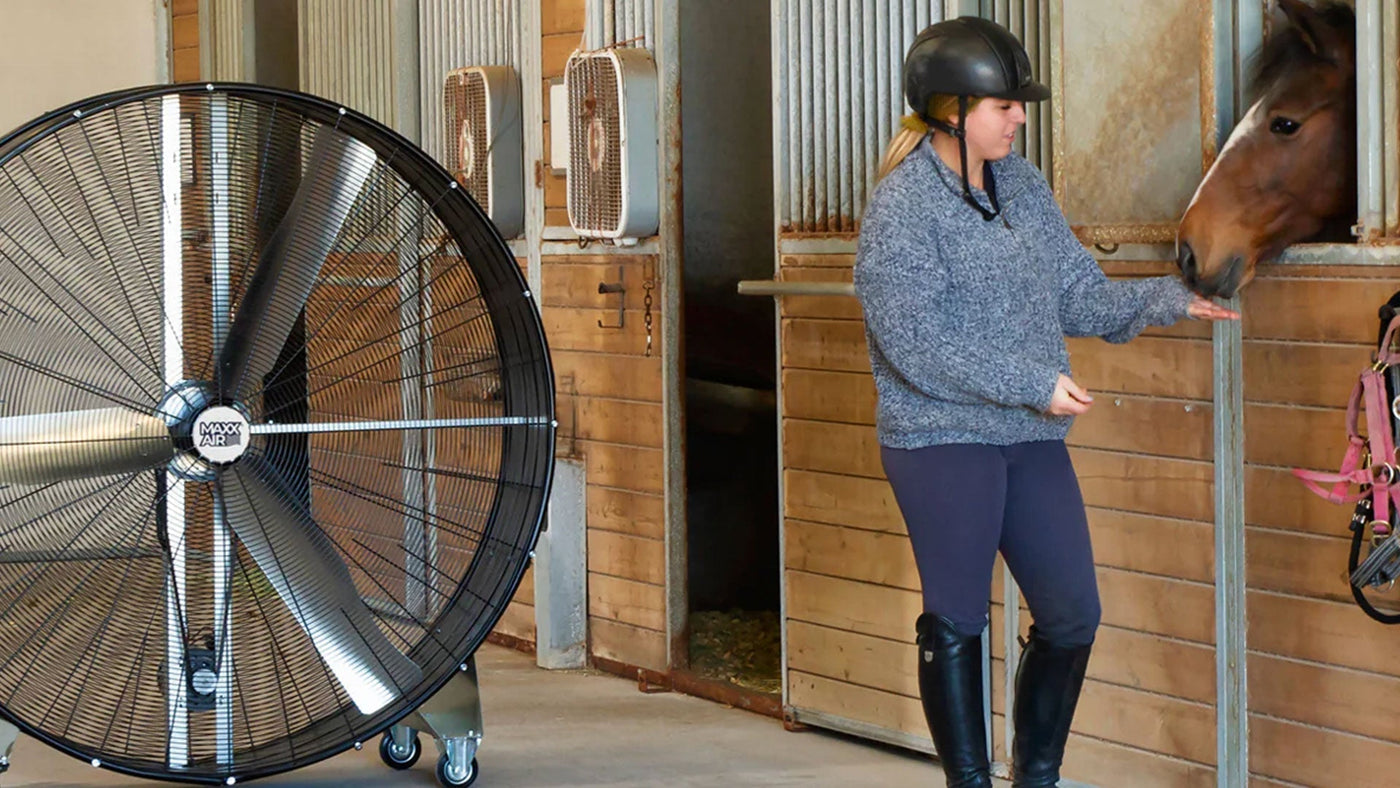
Stables need quieter, more rhythmic airflow than typical industrial spaces because horses can become stressed by harsh wind or loud fan noise. Belt-drive drum fans are often preferred because they deliver a softer, more even air throw than direct-drive models. Wall-mount fans installed up out of reach of curious animals are also common, providing consistent overhead circulation without creating cord hazards in the stall.
Greenhouses and Plant Nurseries
Greenhouses need constant airflow to control humidity, temperature, and plant disease pressure. Stagnant air pockets cause leaf mold, powdery mildew, and heat stress, especially in dense canopies.
A greenhouse fan typically runs almost continuously, often paired with exhaust fans and intake vents for full air exchange, which is why corrosion-resistant construction is essential in this category.
Wall-mount fans help eliminate dead zones across the growing canopy, and corrosion-resistant construction matters because greenhouses stay humid year-round.
What Is the Best Fan for a Greenhouse?
The right greenhouse fan combination depends on what you are growing and the climate. Horizontal airflow (HAF) fans for constant air circulation are typically paired with wall-mount exhaust fans and intake louvers for full air exchange. During cooling cycles, target 1 to 2 complete air changes per minute, which is significantly higher than most commercial spaces because of the heat and humidity load from plants. Totally enclosed motors are essential because greenhouses combine high humidity with airborne organic debris that destroys open-frame motors quickly.
Indoor Riding Arenas
Indoor riding arenas combine drum fans and wall-mount fans to keep large open spaces comfortable for both animals and riders. Airflow needs to be strong enough to circulate the full volume of the arena without creating uncomfortable wind at floor level.
Key Spec Differences Between Categories
The same fan size can mean very different things across categories.
|
Spec |
Residential |
Commercial |
Industrial / Agricultural |
|---|---|---|---|
|
Typical CFM range |
1,000–6,000 |
4,000–15,000 |
10,000–100,000+ |
|
Motor type |
Open frame |
Open or enclosed |
Totally enclosed |
|
Housing material |
Lightweight plastic or light steel |
Powder-coated steel |
Polyethylene or heavy-gauge or galvanized steel |
|
Run time |
Hours per day |
All day |
Continuous |
|
Grille standard |
Decorative |
Safety-rated |
OSHA-compliant |
|
Typical price range |
$50–$400 |
$300–$1,500 |
$1,000–$10,000+ |
Buying a residential fan for an industrial or agricultural space almost always ends in early failure. Buying an industrial fan for a residential space is usually overkill and often too loud or too large for the room.
How Many CFM Does a Commercial Space Need?
The CFM a commercial space needs depends on the size, ceiling height, occupancy, and use of the space. As a general rule, calculate total cubic feet (square footage × ceiling height) and aim for 4 to 6 air changes per hour for office and retail spaces, 6 to 10 air changes for gyms and restaurants, and 10 to 30 air changes for industrial spaces with heat, dust, or fumes. For example, a 5,000-square-foot retail store with 12-foot ceilings has 60,000 cubic feet, requiring 4,000 to 6,000 CFM of fan airflow to achieve 4 to 6 air changes per hour. Spaces with high occupancy, cooking equipment, or industrial processes need to size up significantly to handle the additional heat and air quality load.
How to Know Which Category You Are In
A few questions help place a space in the right category:
- How many hours per day will the fan run?
- How large is the space in square feet?
- Are people or animals in the space all day or just visiting?
- Is the space exposed to dust, humidity, fumes, or chemicals?
- Are there safety regulations to meet (OSHA, food safety, agricultural codes)?
- Does the fan need to operate year-round?
If most answers point toward long run times, large spaces, exposure to dust or moisture, or regulatory requirements, the space probably needs commercial-, industrial-, or agricultural-grade equipment.
Match the Fan to the Job
Residential, commercial, industrial, and agricultural applications all use fans, but they place very different demands on them. The right fan for a bedroom is built for quiet comfort. The right fan for a warehouse is built for continuous airflow. The right fan for a barn is built for dust, moisture, and animal welfare. The right fan for a greenhouse is built to run year-round in humid conditions.
Matching the fan to the job is the difference between a product that lasts a decade and one that fails before its first warranty claim.